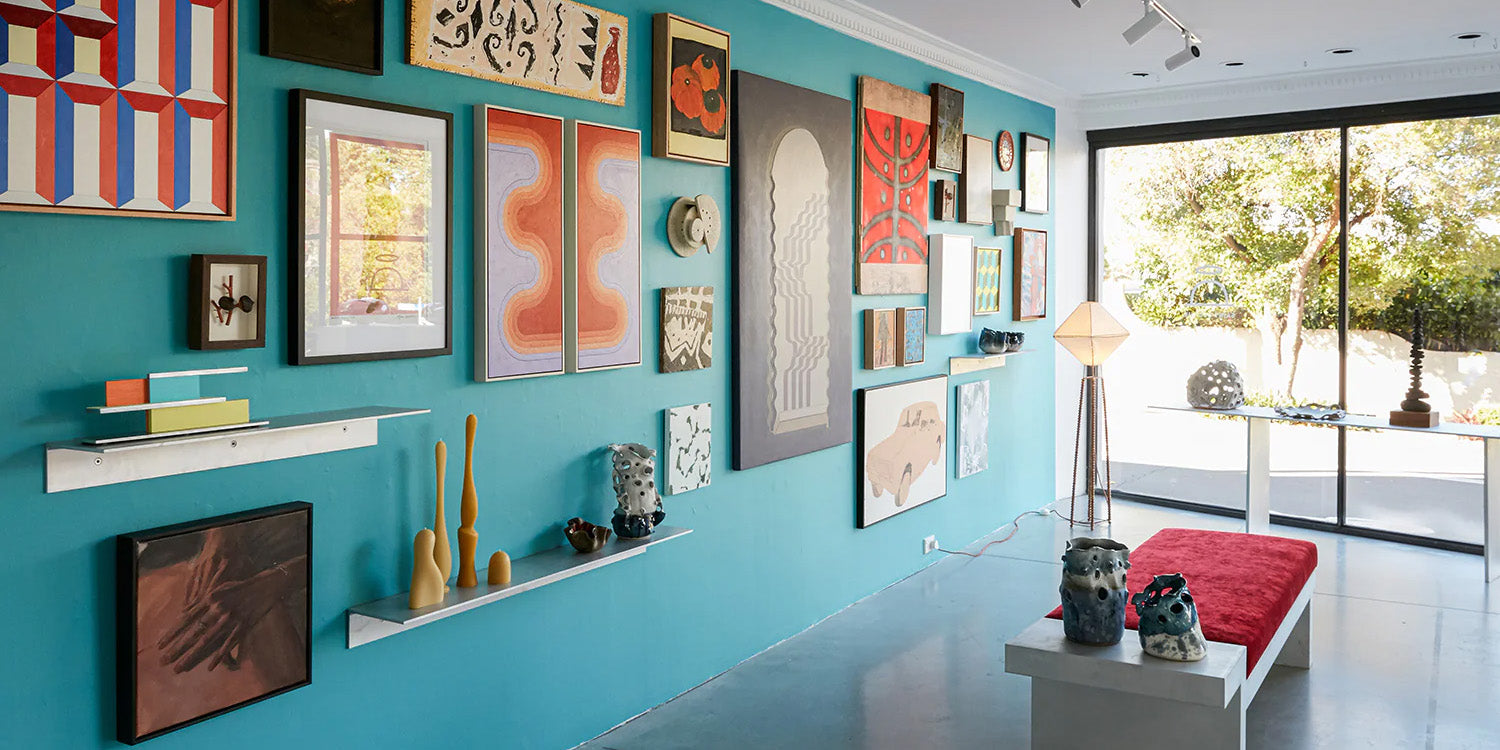
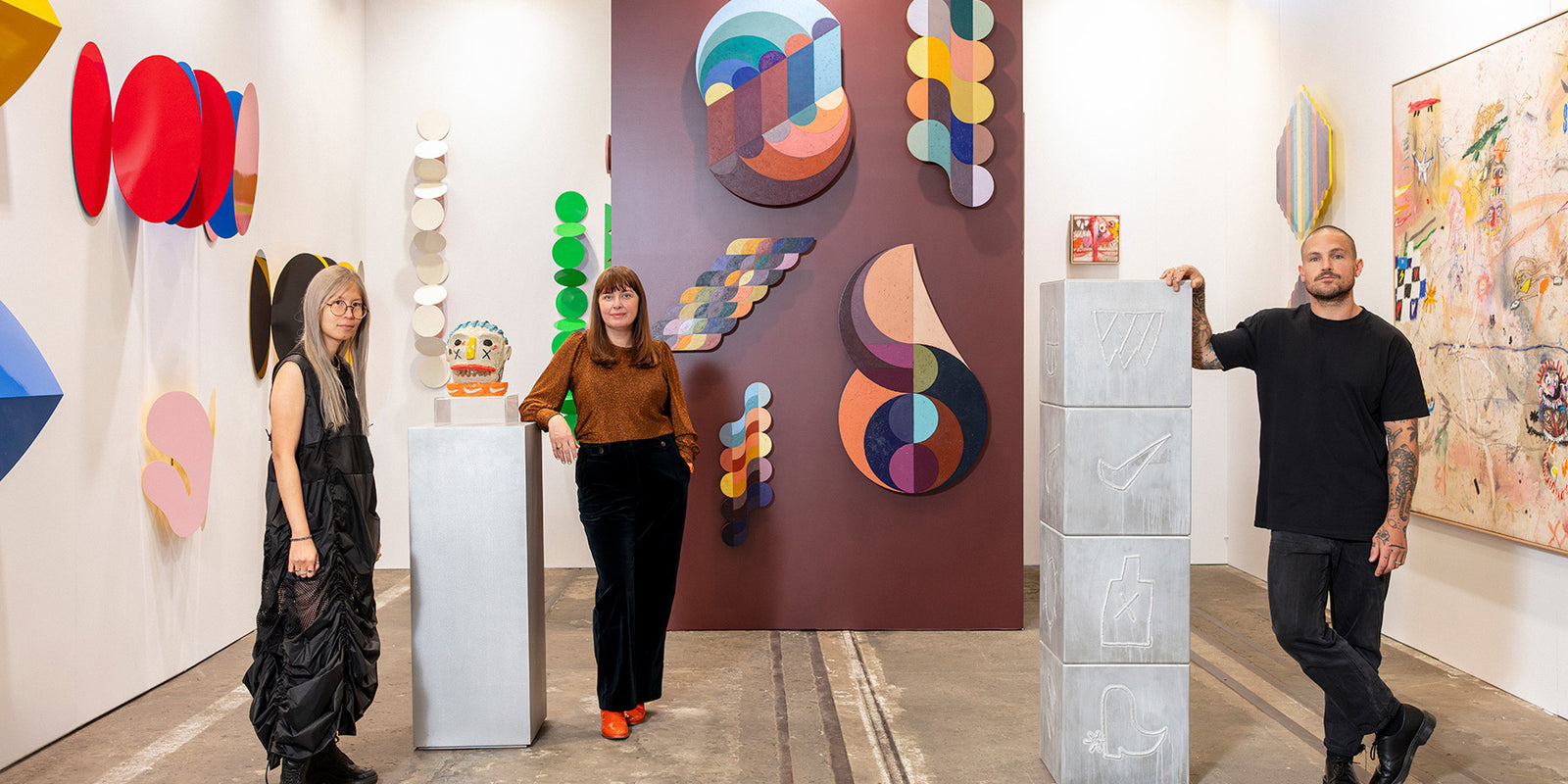
Daimon Downey’s latest body of work proposes happiness as a conscious act - a deliberate positioning of joy within an irrational world. Drawing from the philosophy of Albert Camus, Downey engages the enduring tension between our search for meaning and the universe’s indifference. Rather than resolving this conflict, he reframes it: absurdity becomes liberation, and peace becomes an act of will.
Across poured geometric landscapes and distilled figure paintings, Downey constructs visual fields governed by equilibrium. His compositions are structured yet intuitive — colour calibrated to generate calm, shapes arranged in quiet agreement. The works do not dramatise existential tension; they offer reprieve from it. Painting, for Downey, becomes a site where harmony is rehearsed and made visible.
Downey’s interdisciplinary background informs this sensibility. As a founding member of Sneaky Sound System, he has spent over two decades immersed in the mechanics of collective euphoria — observing how rhythm dissolves boundaries and how strangers achieve temporary unity through sound. The synaesthetic translation of that experience underpins this exhibition: beat becomes geometry, frequency becomes colour, and the dancefloor’s fleeting cohesion is rendered in still form.
The landscape works return to Bellingen in northern New South Wales, where Downey spent his childhood. These are not literal depictions but memory structures - places filtered through emotional recall rather than observation. Hills and riverways operate as autobiographical coordinates, suggesting that joy has geography. The works position landscape as a psychological terrain: formative, internalised, and inseparable from identity.
In parallel, the figure paintings address absurdism more directly. Echoing the philosophical terrain of The Myth of Sisyphus, Downey renders simplified, almost pantomimic faces - characters caught within the theatre of contemporary life. They acknowledge the strangeness of existence without collapsing into despair. Instead, they embody acceptance: a refusal to escape into false certainties, and a willingness to persist regardless.
Across both bodies of work, geometry operates as both structure and metaphor. Edges create containment; colour produces resonance. Between these formal boundaries, Downey locates what he describes as “joy filling the cracks.” If Camus urged us to imagine Sisyphus happy, Downey advances the proposition further - he paints that happiness into form.
This exhibition positions love not as sentiment but as construction: an intentional calibration of colour, balance, and coexistence. In Downey’s practice, peace is not passive. It is composed, defended, and shared.
Read the Essay by Steven Alderton